GEO and SEO in 2026: What Actually Moves AI Visibility
A field-state analysis of generative engine optimization separating what the data supports from what the coaching circuit is selling. Companion announcement to IB-2026-004.
Published on
Author
David Marshall
GEO and SEO in 2026: What Actually Moves AI Visibility
A new intelligence brief is published: The State of GEO/SEO — April 2026 Field Analysis (IB-2026-004).
Why this exists
The coaching circuit around generative engine optimization has gotten loud — and inaccurate. I kept seeing the same set of claims repeated as fact: “talk to ChatGPT about yourself daily and it will surface you to other users,” “post 200 reviews per year or you’re invisible,” “schema markup lifts AI citations by 40%,” “AI Overviews are now on every search.”
None of those hold up against the public data from Semrush, Ahrefs, BrightEdge, Yext, BrightLocal, and HubSpot — the firms actually instrumenting this at scale.
The brief synthesizes 35 sources from the period roughly October 2025 through April 2026 to answer one question: what actually moves AI visibility for a service business in 2026, separated from coaching folklore?
What’s in it
- The mechanism map. Three distinct ways AI engines learn about you: training corpus (frozen at training time), retrieval at query time (live web search inside the answer), and personal context (your account history, which doesn’t propagate). Most coaching content conflates these and gets the strategy wrong.
- The signal hierarchy. Tier 1 (decisive): entity clarity, topical density on a tight surface, multi-source consensus, structured passages, recency, buyer-journey prompt coverage. Tier 2 (strong): schema, third-party coverage, citation-channel diversity, Reddit/LinkedIn presence, review recency. Tier 3 (overstated): backlink count, keyword density, daily content volume.
- A worked example. Maria Chen — a hypothetical Sedona luxury real estate agent — walked through the full GEO playbook, ranked by leverage, with explicit “what she does not do” guardrails.
- A field-test anchor. HubSpot’s AEO evaluator run on Phoenix/Scottsdale/Paradise Valley luxury real estate, showing share-of-voice across Christie’s, Compass, Coldwell Banker, Russ Lyon Sotheby’s, Sotheby’s International Realty, Engel & Völkers, and The Agency — and why the right measurement frame is “do I appear for the prompts buyers actually run,” not “does ChatGPT know my name.”
- The 90-day playbook. Foundation work in days 0–14, content surface area in days 15–45, citation graph development in days 30–75, measurement and iteration through day 90.
- Eight myths to stop spreading, with the citation that disproves each.
- A confidence-level table for every load-bearing claim in the document, so you can see what is well-supported versus what is directional.
Who this is for
- Service practitioners (real estate agents, lawyers, coaches, contractors, brokers, advisors) who want to know what to actually do — and what to stop wasting time on.
- Coaches and consultants teaching GEO to those practitioners, who would rather be the one teaching truth than the one repeating folklore.
- Builders and tool-makers in this space, who can use the signal hierarchy as a product roadmap.
What it does not claim
- It does not claim to predict AI engine behavior six months out. The space moves fast; the brief is dated and time-stamped accordingly.
- It does not claim that any single tactic produces a known-magnitude lift. Most vendor white papers promising “schema lifts citations by X%” do not isolate the variable. The brief is honest about that.
- It does not claim that a brand-owned website is sufficient. A meaningful share of AI citations live on platforms you don’t own — Reddit, LinkedIn, Wikipedia, directories, YouTube — and the brief treats those as part of the surface area, not afterthoughts.
Read the full brief
IB-2026-004: The State of GEO/SEO — April 2026 Field Analysis
If something in there contradicts what you’ve been told by a vendor or coach, the brief shows the source. If something in there contradicts what I’ve said before, the brief is the corrected version. The whole point of dating the analysis and listing the sources is that it is a snapshot of the field — and the field will move.
Published 2026-05-04. Companion to IB-2026-004. Sources and methodology in the full brief.
Share:
Building something with AI? Let's compare notes.
No pitch, no newsletter, just real talk about building with AI.
Latest reflections
The Website That Taught Me I Could Build
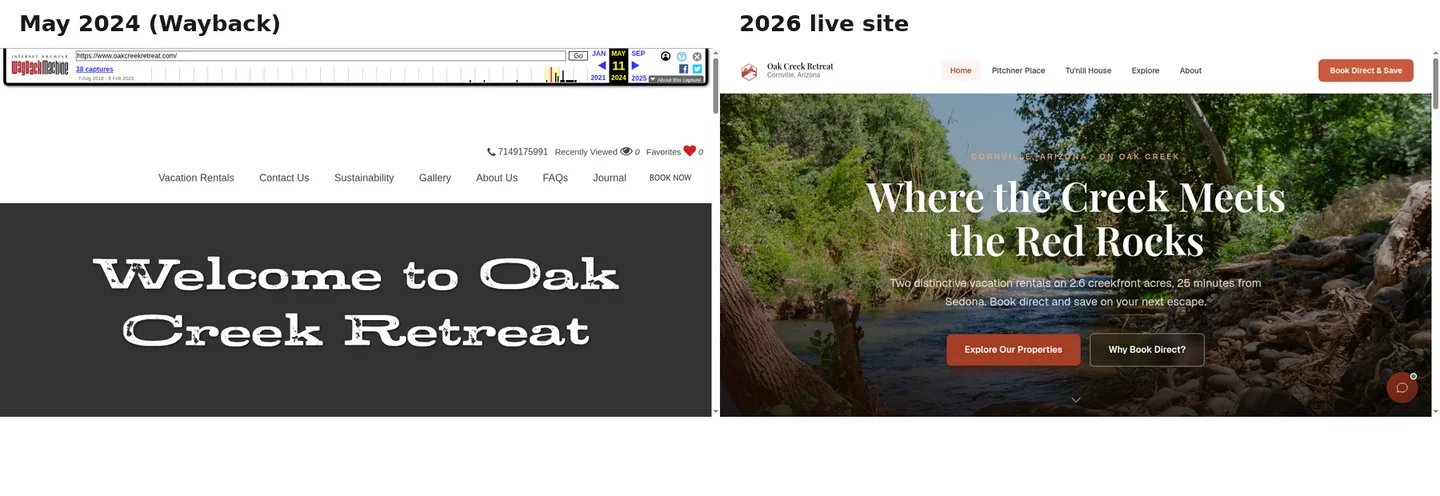
A vacation-rental website took me from paying for a generic experience to building and operating a direct-booking system with AI.

The most useful app I've built with AI has three users
A personal family day-coordination app with three users and no AI brain. How deterministic rules, voice-to-review-to-save, and a bounded problem made tiny software worth building.